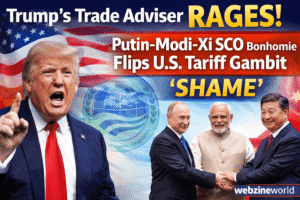
In a world already strained by trade wars and geopolitical rivalries, words matter—and India’s Prime Minister Narendra Modi didn’t mince his.
After holding high-profile meetings with Vladimir Putin and Xi Jinping at the Shanghai Cooperation Organisation (SCO) Summit, Modi delivered a sharp critique of protectionist trade policies—remarks widely interpreted as a direct swipe at Donald Trump and his tariff-heavy economic strategy.
His message was blunt, global, and impossible to ignore.
‘Selfish Economies’ and a Clear Signal
Without naming Trump directly, Modi warned against what he described as “selfish economic policies” that disrupt global supply chains and hurt developing nations.
The timing was crucial.
Coming just after visible camaraderie with Russia and China—two frequent targets of U.S. trade pressure—Modi’s remarks sounded less like diplomacy and more like strategic defiance.
The subtext was unmistakable:
Tariffs are not leadership. Cooperation is.
Why Trump’s Tariffs Are Back in the Spotlight
Trump’s tariff strategy was built on a simple belief:
- Economic pressure forces compliance
- Trade deficits equal national weakness
- Protectionism restores domestic strength
But critics argue the real outcome has been:
- Higher costs for consumers
- Fragmented global trade
- Accelerated non-Western alliances
Modi’s comments reflect a growing global consensus that tariff wars often hurt cooperation more than they help economies.
The SCO Factor: Why This Moment Matters
The SCO is no longer just a regional forum. It represents:
- Nearly half the world’s population
- Major energy producers and consumers
- A non-Western alternative to global governance
Modi’s engagement with Putin and Xi at this platform sends a strong message:
India will not be boxed into economic binaries.
Instead of choosing sides, New Delhi is choosing strategic autonomy.
India’s Trade Philosophy: Growth Through Cooperation
Unlike tariff-first approaches, India’s current trade vision emphasizes:
- Multilateralism over unilateral pressure
- Open supply chains
- Development-focused globalization
By criticizing “selfish economies,” Modi positioned India as a voice for nations that want fair trade—not forced trade.
It’s a stance that resonates deeply across Asia, Africa, and the Global South.
Washington’s Dilemma
For the U.S., this moment is uncomfortable.
When a country like India—once seen as a natural counterweight to China—publicly pushes back against tariff nationalism, it raises a bigger question:
Is America’s pressure-first strategy losing its influence?
Modi’s remarks suggest that global leadership today is measured less by economic threats and more by trust and partnership.
A Shift in the Global Economic Mood
What we’re witnessing may be a transition from:
- Tariff-driven dominance
to - Alliance-driven negotiation
Modi’s language wasn’t just criticism—it was a warning that economic isolationism creates fractures the world can no longer afford.
POV
Modi’s post-SCO remarks weren’t accidental, emotional, or symbolic.
They were calculated.
By calling out “selfish economies” after meeting Putin and Xi, India’s prime minister made it clear:
the future belongs to cooperation, not coercion.
For Trump-era tariff politics, that’s a reality check the world is increasingly ready to deliver.